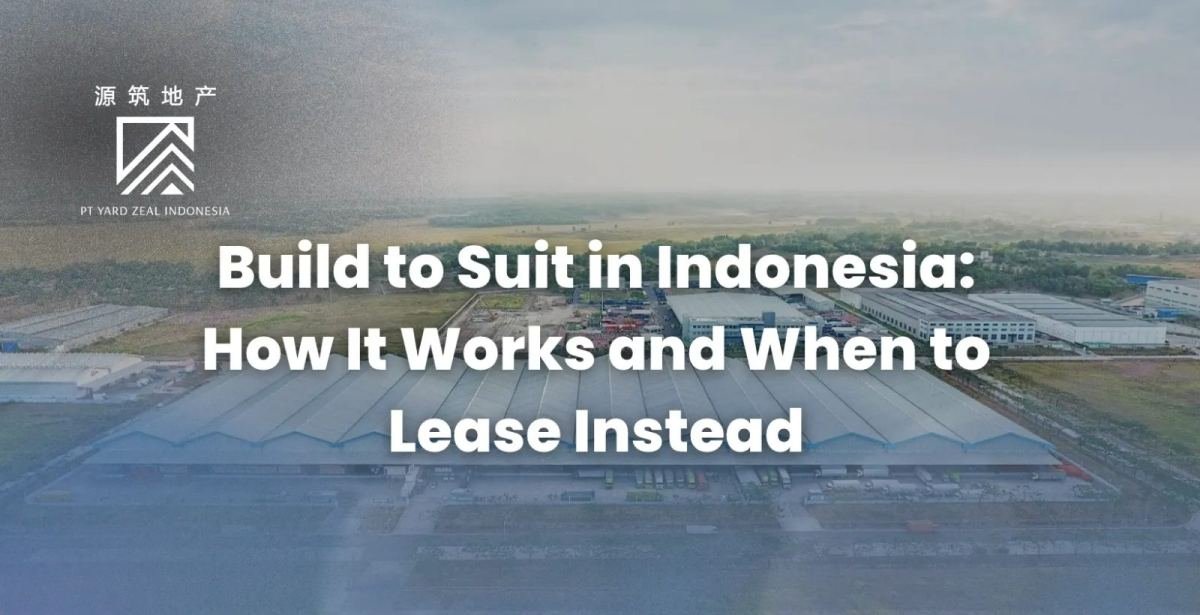
Build to suit in Indonesia means a developer or industrial estate designs and builds a factory or warehouse to one occupier’s specification, then leases it, or occasionally sells it, to that occupier under a long contract. Build to suit Indonesia deals are usually pre-lets: the lease is signed before construction starts and typically runs well beyond the 2–3 year terms common for standard industrial space. If your requirements fit a building that already exists, a ready-built unit is usually faster.
The short version:
What it is: a custom building delivered by a developer for one named occupier, who commits before it is built.
Typical commitment: one 2026 Indonesian example is a 10-year lease signed about a year before targeted completion.
Main alternatives: a ready-built factory or warehouse lease, or buying land and building yourself.
What still applies: a PBG before construction, an SLF before use, and the estate’s own rules.
What does build to suit mean in Indonesia?
Build to suit (BTS) is a development model in which a building is designed and constructed for one occupier’s requirements instead of being built speculatively for the general market. Kontan described it in 2016 as building property to a tenant’s order, when Puradelta planned BTS warehouses at Kota Deltamas. The developer typically funds land and construction and keeps the asset; the occupier pays rent.
“BTS” has two other meanings in Indonesia: telecom companies use “built to suit” for towers erected for a mobile operator, and BTS is also the usual abbreviation for a mobile base station. For factories and warehouses, it means only the custom-building model described here.
Several estates and developers publish BTS offers. Jababeka lists a built-to-suit factory product next to its standard factory buildings, and Frasers Property’s logistics park in Karawang advertises custom built-to-suit space with 1.7 ha listed as available for BTS (checked 30 October 2026). BTS is one of several routes covered in our guide to warehouse and factory leasing in Indonesia.
How does a build-to-suit project work?
A build-to-suit project in Indonesia moves from a written specification to a signed lease before any construction, then through permits, building and handover. A developer typically builds only once the occupier is contractually committed.
Specification. The occupier defines floor area, clear height, floor load, power, loading docks and process needs such as cranes or cold rooms.
Site and offer. The developer proposes a plot, a layout and a rent based on its land and construction cost.
Pre-lease agreement. Both sides sign before building starts. The lease fixes the term, the rent and what happens if construction runs late.
Permits. The owner must apply for a PBG (building approval) before construction, under Article 253(4) of PP 16/2021, and hold an SLF (certificate of fitness for use) before the building is used, under Article 274.
Construction and handover. The occupier inspects the building against the agreed specification, then fits it out and starts operating.
A 2026 deal shows the pace. Argo Pantes signed a 120-month lease with J&T Cargo on 11 February 2026 for a BTS warehouse in Tangerang, worth about Rp221 billion. It broke ground on 24 April 2026 and is targeting completion in February 2027, according to BCA Sekuritas. That is roughly a year from signing to targeted completion.
Build to suit vs lease in Indonesia: which fits your project?
Build to suit and a standard lease differ mainly in commitment length, customisation and speed; buying land is the third route. Each option uses the same five attributes.
Build to suit (lease)
Upfront capital: low, because the developer funds land and building. CBRE’s Q2 2026 Greater Jakarta industrial outlook says BTS stays attractive to occupiers who want to reduce upfront capital while meeting specific operating needs.
Commitment: long. The Argo Pantes and J&T Cargo lease runs 10 years.
Time to occupy: permits plus construction, about 12 months targeted in the 2026 example.
Customisation: high, fixed at the specification stage.
Flexibility: low. Leaving early is costly, because the building was made for one user.
Ready-built lease
Upfront capital: low. Colliers’ Jakarta occupier guide lists upfront rent, a security deposit or a corporate guarantee as typical requirements, noting three months’ gross rent (rent plus service charge).
Commitment: shorter. Colliers puts typical industrial lease terms at 2–3 years.
Time to occupy: typically weeks to a few months, depending on fit-out.
Customisation: limited to the existing building.
Flexibility: higher, with terms renegotiated at each renewal.
Buy land and build
Upfront capital: the highest. Industrial land in Cikarang, Greater Jakarta’s most expensive submarket, was about Rp3.6 million per m² in Q2 2026, according to CBRE’s estate figures, before any construction. Our industrial land price guide compares estates.
Commitment: ownership, usually through HGB.
Time to occupy: the longest, because land acquisition, permits and construction run in sequence.
Customisation: full.
Flexibility: the asset can be sold, though that takes time and carries tax.
Tax and accounting differ as well. Rent for land or buildings carries a 10% final income tax under PP 34/2017, usually withheld by a corporate tenant, and a VAT-registered landlord charges VAT at an effective 11% under PMK 131/2024; see our rental tax guide. Buying means 2.5% final income tax for the seller under PP 34/2016 and up to 5% BPHTB for the buyer under Article 47(1) of UU 1/2022. In the accounts, a long lease generally appears on the tenant’s balance sheet under PSAK 116, formerly PSAK 73, the Indonesian standard consistent with IFRS 16.
When does a ready-built factory in Indonesia make more sense?
A ready-built factory in Indonesia makes more sense when your requirements fit a unit that already exists and you need to start within months. Estates publish standard factory buildings in fixed sizes. Kota Bukit Indah, for example, lists units from 603 m² (ST-5) to 7,173 m² (ST-3), with a minimum three-year lease and a two-month fit-out grace period. Our standard factory building guide compares seven estates’ published sizes, heights and floor loads.
Current demand shows where that line tends to fall. Of the 77 active requests on the Yardzeal client requirements board on 30 October 2026, 33 are factory requests that state a size. Nine of those need 8,000 m² or more, larger than Kota Bukit Indah’s biggest standard unit, so they will likely need a BTS building, an existing large building or land. Another 11 requests are for land, from 5,000 m² to 66 ha.
IDNFinancials reported in May 2026 that Chinese manufacturers are driving growing demand for ready-built factories, and JLL said earlier standard factory buildings were often little more than shophouses with warehouses that did not meet manufacturers’ specifications. That gap is where BTS fits.
What should a built to suit warehouse include?
A built to suit warehouse should be specified around the operation it serves: racking height, forklift and truck traffic, floor load and the number of loading docks. These are cheapest to get right before construction and hardest to change afterwards.
Benchmarks for Grade A logistics space in KF Map’s guide to modern warehouse standards include:
clear height above 10 m;
floor load above 3 t/m² for a single storey;
a column grid of at least 17.5 × 17.5 m;
about one loading dock per 1,000 m² of net lettable area.
Not every operation needs Grade A, and bonded storage adds customs requirements of its own, covered in our bonded zone guide.
Which permits and land rights apply to a BTS building?
A BTS building in Indonesia needs the same approvals as any other industrial building, and the developer, as building owner, obtains them, since PP 16/2021 places both duties on the owner. The estate’s own rules apply on top.
Location rules apply as well. Under Article 62(1) of PP 20/2024, industrial companies must locate in an industrial estate, with exceptions in Article 62(2) and (3), such as small industry or regencies or cities without an estate. Our industrial park permit guide covers the estate side.
Land rights decide who owns what. As an Indonesian legal entity, a PT PMA can hold Hak Guna Bangunan (HGB) under Article 34 of PP 18/2021, and Article 37 sets the HGB term on state or HPL land at up to 30 years, extendable by 20 and renewable for 30. Companies generally hold HGB rather than freehold Hak Milik, so in a BTS lease, check that the developer’s HGB runs beyond your lease term. Our guide to land ownership for a PT PMA explains the options.
This article is general information, not legal or tax advice.
What are the common build-to-suit mistakes?
The most common build-to-suit mistakes come from fixing the specification too late or the lease terms too loosely.
Late specification changes. These usually move both the rent and the handover date.
No remedy for late delivery. The lease should say what happens if handover slips, such as rent-free time or a right to terminate.
Ignoring the exit. A 10-year lease on a custom building is hard to assign, so agree assignment and early-termination terms at the start. Our warehouse lease agreement guide lists the clauses to check.
Unchecked land title. Confirm the HGB expiry and any mortgage.
Assuming BTS is always cheaper. Rent reflects the developer’s land and construction cost plus its return, so compare the total cost over the full term with a standard lease and with buying.
Checklist before signing a BTS lease
A written specification with tolerances for height, floor load, power and docks.
The lease term, rent, escalation and rent start date.
The handover date and the remedy if it slips.
Copies of the PBG and SLF before you move in.
The developer’s HGB and its expiry date.
Assignment and early-termination terms.
FAQ
What is the difference between build to suit and build to lease?
Build to suit starts with a named occupier who signs before construction, so the building follows that occupier’s specification. Build to lease, often called speculative development, is built to a general specification first and leased afterwards to whoever takes it, which usually means shorter commitments and less customisation.
How long does a build-to-suit project take in Indonesia?
It depends on the building’s size, the permits and whether the plot is ready. In the 2026 Argo Pantes and J&T Cargo warehouse, the target completion date is about a year after the lease was signed. Allow extra time for the occupier’s own fit-out.
Can a build-to-suit factory be bought instead of leased?
A purchase is possible if the developer agrees, but the published Indonesian BTS offers we found are lease structures. If you buy, the seller pays 2.5% final income tax, you pay BPHTB of up to 5%, and the buying company needs a land right it can hold, usually HGB.
Is build to suit cheaper than a standard lease?
Not necessarily. BTS rent reflects the developer’s land and construction cost plus its return over a long term. Compare the total cost across the whole lease with a ready-built lease and with buying, rather than comparing monthly rent alone.
What happens if a build-to-suit building is delivered late?
That depends entirely on the lease. Agree a handover date, a grace period and a remedy before signing, such as rent-free time or a right to terminate. Without those clauses, the occupier carries the cost of the delay.
What size of project usually suits build to suit?
There is no official minimum. BTS tends to make sense when a requirement is larger than the standard units on offer, such as above Kota Bukit Indah’s largest published unit of 7,173 m², or when it needs a specification that existing buildings cannot meet.
Exploring build to suit in Indonesia
If you are weighing a build to suit Indonesia project against a ready-built unit, current occupier demand is a useful reference point. The client requirements board lists the sizes, locations and products that companies are asking for now. To see what factory and warehouse occupiers need, visit Yardzeal.
This article is part of our Warehouses & Factories guides.
See all articles on Warehouses & Factories