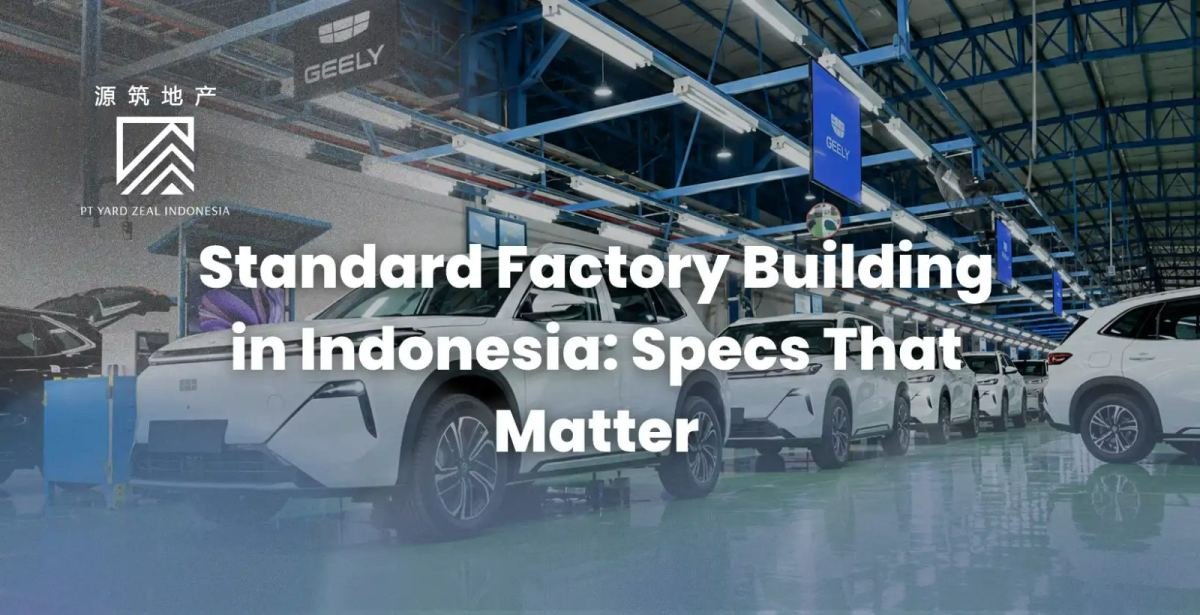
A standard factory building in Indonesia is a ready-built factory unit that an industrial estate puts up to a set design and then leases or sells to manufacturers. It usually comes with a production hall, a small office or mezzanine and a power connection already in place. The word “standard” can mislead, though: published units range from under 300 m² to more than 7,000 m², and production-floor loads quoted by estates run from 750 kg/m² to 3.5 tonnes per m². Below are the specifications that matter, how they compare between estates and with modern warehouses, and what to check before choosing a unit.
The short version:
What it is: a pre-built factory unit with a standard design, located inside an industrial estate, offered for lease or sale.
Size: published units run from about 270 m² to about 7,200 m² of lettable area.
Height: published heights run from 5.95 m to the roof to 9.4 m clearance. Grade A logistics warehouses exceed 10 m clear.
Floor load: from 750 kg/m² to 3.5 t/m², depending on the estate.
Power: from a 16,500 VA connection to medium-voltage supply. The figure in the lease is what you can actually use.
What is a standard factory building in Indonesia?
A standard factory building (SFB) in Indonesia, known locally as bangunan pabrik siap pakai, is a factory unit built in advance by an estate developer to a uniform design. Tenants or buyers move in and fit out the space instead of designing and building their own. MM2100 describes its BeFa Industrial Hub units as ready-built factories with standardised specifications that can be customised “within defined limits”.
SFBs usually sit in clusters inside estates that already provide roads, water, security and power. Estates that publish SFB or rental factory products include MM2100, Deltamas, Jababeka, Kota Bukit Indah, KIIC, Suryacipta (SLP) and Industropolis Batang. Most units are offered for lease, while some, such as BeFa, are sold.
How do standard factory building specs compare between estates?
Standard factory building specs vary widely between estates. Size, height, floor load and power all differ. These are the figures each estate publishes on its website, checked in October 2026.
BeFa Industrial Hub, MM2100 (Bekasi): about 680 m² of building on 1,120–1,456 m² of land, floor load up to 2 t/m², power up to 16,500 VA, sold from Rp12 billion.
Deltamas (Bekasi): three rental types of about 1,070–2,270 m² of building (on plots of up to 4,122 m²), with a 33,000 VA PLN supply reported in the press.
Kota Bukit Indah (Purwakarta): type ST-1 has 1,717 m² of lettable area, 6.2 m from ground floor to roof, 750 kg/m² on the production floor and 250 kg/m² on the mezzanine, with a 380 V or 20 kV connection, per its spec page. Other types run from ST-5 (603 m², 6.88 m to the roof) to ST-3 (7,173 m², 7.31 m).
Industropolis Batang (Central Java): Type A covers 1,238 m² with 9.4 m height clearance, and Type C covers 1,815 m² with 8 m, according to its product page. Its smallest, Type E, is 273 m².
Jababeka (Cikarang): Premium Smart Factory Building units have about 830 m² of production space and 205 m² of office.
KIIC (Karawang): rental factories of 1,400–3,500 m², with factory floors rated at 3.5 t/m² and a 22,000 V supply.
Two units of the same size can suit very different operations. For estate-level detail, see our guides to Cikarang and Batang.
What is the standard factory building height?
No national regulation prescribes a standard factory building height, and local zoning can only cap the maximum, so each estate chooses its own. Published SFB figures range from 5.95 to 7.31 m from ground floor to roof at Kota Bukit Indah to 8–9.4 m clearance at Industropolis Batang.
The measurement matters as much as the number. Clear height (the usable space under the lowest beam or fitting) is lower than the height to the roof peak. Under Permen PU 26/2008 on fire protection, at least 50 cm must generally stay free between a sprinkler deflector and the top of stored goods, which reduces usable stacking height further.
The standard warehouse building height is higher. A Knight Frank KF Map article, citing a grading table from Jabodetabek estate operators, lists clear height above 10 m as a Grade A criterion. ESR publishes 10–13.9 m for Cikarang Logistics Park 1. The often-repeated “9–12 m” appears mainly in contractor and supplier content; we found no regulation that sets it.
What floor load does a factory need?
A factory needs a floor load that covers its heaviest machines, stacked goods and forklift traffic. Estates quote between 750 kg/m² and 3.5 t/m² for SFB production floors. Indonesia’s loading standard, SNI 1727:2020, sets minimum design live loads of 6.00 kN/m² for light storage and 11.97 kN/m², about 1.2 t/m², for heavy storage. Engineers must use the actual equipment or stored weight where it is higher.
That gap explains why estates advertise floor load at all. A unit rated at 750 kg/m² suits assembly or light storage. The Grade A criteria on KF Map call for more than 3 t/m² in a single-storey warehouse. KIIC publishes 3.5 t/m² for its rental factories, and ESR publishes 3 t/m² for Cikarang Logistics Park 1. Point loads from racking legs and machine feet can exceed an even spread, so ask for the slab thickness and design load in writing.
How much power does a factory need?
The power a factory needs depends on its machines, but in Indonesia it is stated as the connected capacity in kVA (kilovolt-amperes). That is the capacity the tenant buys from PLN or the estate’s electricity company. Cikarang Listrindo, which supplies estates including MM2100 and Jababeka, defines energised kVA as the capacity each estate customer has purchased.
Where PLN supplies the factory, the factory power supply falls into PLN’s industrial tariff groups. Under Permen ESDM 7/2024, group I-3 covers medium-voltage connections above 200 kVA and below 30,000 kVA, and I-4 covers 30,000 kVA or more. Connections up to 200 kVA are low voltage. Estates served by a private utility such as Cikarang Listrindo use that utility’s tariffs.
As a rough guide, usable power in kW is the kVA figure multiplied by the power factor, often around 0.8 to 0.9. A 16,500 VA unit therefore gives roughly 13–15 kW, enough for lighting, offices and light assembly but not for heavy machinery. Some SFBs, such as BeFa at MM2100 and Jababeka’s Premium Smart Factory Building, are offered at about 16.5 kVA, so ask who pays for an upgrade, how long it takes, and whether the estate’s substation has spare capacity. Our guide to industrial estate facilities explains how estate utilities work.
How is a standard factory building different from a modern warehouse?
A standard factory building is smaller and lower than a modern warehouse and includes office space, while a modern warehouse is built for racking and fast truck turnover. Comparing both on the same warehouse specifications makes the difference clear.
Standard factory building
Typical size: about 270–7,200 m² per unit.
Height: 5.95–9.4 m in published examples.
Floor load: 750 kg/m² to 3.5 t/m².
Loading: roller doors or a few docks. SLP’s rental factory, for example, has three loading docks.
Office: built in, often as a mezzanine.
Modern logistics warehouse
Typical size: units within large multi-tenant parks. ESR Cikarang Logistics Park 1 totals 70,710 m².
Height: above 10 m clear (Grade A criteria, KF Map).
Floor load: more than 3 t/m² single storey (Grade A criteria, KF Map).
Loading: about one dock per 1,000 m², with column grids of at least 17.5 m by 17.5 m (Grade A criteria).
Office: a small office block.
Rent follows these differences, so compare quotes with our warehouse rental rates guide.
Is a standard factory building the right fit?
A standard factory building fits a manufacturer that needs a small to mid-sized unit quickly and can work within the published specifications. Its main advantages are speed and a ready estate setting. Its limits are fixed height, floor load, power and layout.
Size is often the deciding factor. Of the 28 factory lease requests on the Yardzeal client requirements page that state a size, 22 need 2,000 m² or more as of 21 October 2026, larger than many published SFB units. None of the 77 requests on the board mentions power, height or floor load. Those specifications usually come up only at the site visit, so it pays to raise them earlier.
Permits matter too. Under PP 16/2021, a building needs a building approval (PBG) before construction and a certificate of worthiness for use (SLF) before it is used. For buildings other than houses, the SLF must be renewed every five years.
What should you check before choosing a standard factory building?
Before choosing a standard factory building, check the numbers that limit your operation, in writing.
Area and layout: production area, office and mezzanine, and column positions.
Clear height: under the lowest beam or fitting, not to the roof peak.
Floor load: the design load in kg/m² or t/m², the slab thickness, and limits on point loads.
Power: the connected kVA, the voltage, the supplier (PLN or estate), and the cost and lead time of an upgrade.
Permits: a PBG and a valid SLF, and zoning that allows your activity. Our KKPR guide explains the zoning check.
Access: truck turning space and door sizes for your largest vehicle.
Lease terms: fit-out rights and reinstatement. Our warehouse and factory leasing guide covers the main terms.
FAQ
Is there a national standard for factory buildings?
No single national size or design applies. “Standard” usually means the estate’s own fixed design. The building must still meet the technical standards for buildings that a PBG is based on under PP 16/2021.
Can you buy a standard factory building instead of renting one?
Yes, in some estates. MM2100 sells its BeFa Industrial Hub units, for example, while most other estates lease theirs. A purchase usually comes with a land title in the estate, so our guide to PT PMA land ownership is worth reading if the buyer is foreign-owned.
Can a standard factory building be modified?
Usually only within limits set by the estate. Interior fit-out is common, but structural changes need the owner’s consent and may need an amended building approval (PBG), because PP 16/2021 covers changing and extending buildings as well as building new ones.
Can a standard factory building be used as a warehouse?
Yes, for small-scale storage. Its lower height, fewer docks and often smaller column spacing make it less efficient than a modern logistics warehouse for high racking or heavy truck traffic.
What is the difference between kVA and kW?
kVA is the apparent power a connection can carry, while kW is the real power machines use. Multiply kVA by the power factor, often 0.8 to 0.9, to estimate usable kW.
Does a standard factory building come with permits?
The building itself should already have a PBG and a valid SLF. The tenant still needs its own business licence for its activity, registered under the right KBLI code through the OSS system.
Can a standard factory building operate as a bonded factory?
It can, if the company and the building meet the customs requirements for a bonded zone licence. Check with the estate before signing. Our bonded zone guide explains the licence.
Choosing a standard factory building in Indonesia
A standard factory building in Indonesia can save months of construction, but only if its height, floor load and power match the work planned inside. Comparing units on those numbers, rather than on floor area alone, avoids costly surprises after moving in. To see what factory and warehouse space occupiers are currently looking for, visit Yardzeal.