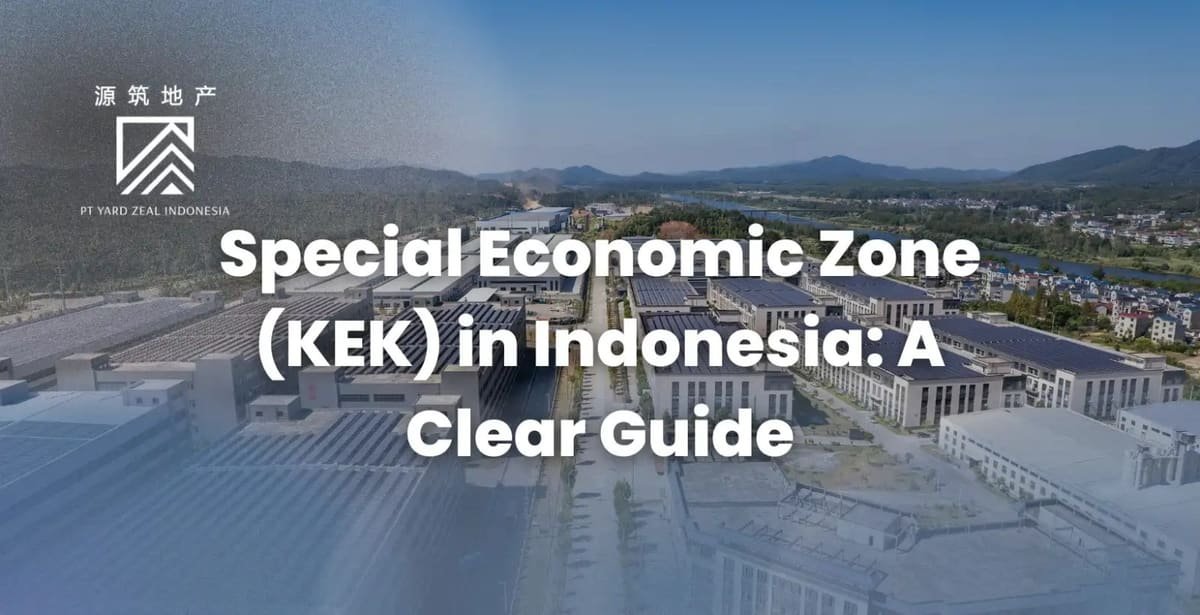
A special economic zone in Indonesia is an area given its own legal regime — tax incentives, customs treatment and streamlined licensing — to attract qualifying investment. As of mid-2026 there are 25 designated zones, with cumulative realised investment of IDR 368 trillion and 283,234 workers at 28 July 2026. What distinguishes an SEZ is not infrastructure but legal status.
Read those figures whole. First-half 2026 realisation fell 21% year on year, and the headline incentive changed in value in 2025 for large multinational groups.
The short version:
An SEZ is a legal regime, not merely an estate
The basis is Law 39/2009 as amended by the Job Creation Law, with PP 40/2021
The tax holiday can reach 100% for 10 to 20 years from IDR 100 billion invested
Since 2025 the global minimum tax restores a 15% effective rate for groups above EUR 750 million
Incentives attach to qualifying activity inside the boundary, never to land ownership
What a special economic zone in Indonesia actually is
An SEZ is a creature of statute, which is why its incentives are more than marketing. The basis is Law 39/2009 on Special Economic Zones, as amended by Law 11/2020 on Job Creation and subsequently enacted as Law 6/2023, with implementation under Government Regulation 40/2021.
The Job Creation amendments matter and are almost always omitted. Private companies can now propose a zone provided they already control at least half the land; the Administrator’s powers widened; the industrial estate licence is no longer required for a designated SEZ; and permitted sectors expanded to include education and health.
Each zone is designated by its own government regulation, which fixes both its area and precisely which business activities are permitted inside it. Oversight sits with the National KEK Council, chaired by the Coordinating Minister for Economic Affairs and answerable to the President.
How many zones there are, and how active they are
Twenty-five zones are designated. That is not the same as twenty-five operating at capacity, and the distinction is rarely drawn.
The government’s own evaluation found that of 24 zones assessed, only four had attracted more than IDR 20 trillion: Gresik, Kendal, Galang Batang and Sei Mangkei — all on Java and Sumatra. Several others have barely moved. One zone lost its status outright: KEK Tanjung Api-Api in South Sumatra, by PP 2/2022, because development was never completed and it could not be declared ready to operate.
The successful zones face the opposite problem. Gresik, Kendal and Galang Batang are reported at capacity and seeking expansions of roughly double their footprint. The government targets 31 zones by end-2026, with six awaiting signature of their regulations.
What the incentives actually pay
The numbers exist, and they are rarely quoted in full. SEZ facilities sit in PMK 237/PMK.010/2020 as amended by PMK 33/PMK.010/2021 — note the PMK.010 suffix, frequently miscited as PMK.03.
A 100% corporate income tax reduction applies to main business activities with a minimum investment of IDR 100 billion. The zone developer gets 10 years. A tenant operator gets 10 years for IDR 100 billion to under IDR 500 billion, 15 years for IDR 500 billion to under IDR 1 trillion, and 20 years above IDR 1 trillion. A further 50% reduction runs for two years after that.
As an alternative, a tenant may take the investment allowance instead: a 30% net income reduction spread over six years, accelerated depreciation, 10% withholding on dividends paid to non-residents against the usual 20%, and a ten-year loss carry-forward.
VAT and luxury sales tax are “not collected” on qualifying imports and deliveries within the zone. The wording matters — not collected, not exempt, and not zero-rated, because the distinction affects input tax crediting.
Customs treatment splits by phase. A zone developer gets exemption from import duty on capital goods during construction. A tenant gets deferral of import duty on machinery and raw materials during production, conditional on running an IT-based inventory system. Excise relief exists but is narrow: only where excisable goods are inputs to a final product that is not itself excisable.
PP 40/2021 also obliges regional governments to grant local tax relief to SEZ businesses, including reductions in land and building acquisition duty and land and building tax. The percentages sit in local regulations, so there is no single national figure.
The global minimum tax changed what a tax holiday is worth
This is the part almost no SEZ guide mentions, and since 2025 it is decisive.
Indonesia adopted the global minimum tax through PMK 136/2024, effective 1 January 2025, covering multinational groups with consolidated revenue of at least EUR 750 million. The domestic top-up applied from the start of 2025 and the undertaxed profits rule from the start of 2026.
The consequence is direct. Where an in-scope group enjoys an SEZ tax holiday that drives its effective rate near zero, Indonesia collects the difference up to a 15% effective rate. Because Indonesia’s domestic rules gained qualified status in August 2025, that top-up is collected in Indonesia rather than by the parent’s jurisdiction. For a group that size, a tax holiday no longer means no tax — it means 15%.
The mechanism differs from the general pioneer-industry regime: for SEZs the top-up arrives through PMK 136/2024 directly, not through a clause in the pioneer tax holiday rules.
For investors below the EUR 750 million threshold the incentive remains fully intact. The government has been preparing a replacement built on refundable tax credits, but as of September 2026 no regulation had been issued.
How a business qualifies
Incentives do not attach to a company automatically. The conditions stack: sit inside the designated boundary, hold land with defined limits within it, be a domestic corporate taxpayer, hold business licensing, and carry on an activity the zone’s own regulation permits.
Applications run through the OSS system. The income tax decision is issued by BKPM on behalf of the Minister of Finance within five working days of a complete application, and must be filed within one year of the business licence. Customs facilities run separately, applied for through the Administrator, which forwards a recommendation to the local customs office.
This is where the Administrator’s role is commonly overstated. It does hold licensing authority inside the zone — reinforced by PP 28/2025 — but it exercises that authority through OSS rather than as a separate counter, and it does not decide tax or customs facilities. For how licensing works more broadly, see our industrial park permits guide.
Not only factories: the sector spread
Of the 25 zones, roughly 14 are industrial, 8 tourism, and the remainder digital and education.
On the industrial side: KEK Kendal (PP 85/2019, 1,000 hectares), KEK Gresik (PP 71/2021, 2,167 hectares, developed as JIIPE), KEK Sei Mangkei (PP 29/2012, palm and rubber downstreaming), and KEK Industropolis Batang (PP 12/2025, 2,886.87 hectares), designated in March 2025.
On tourism: Mandalika, Likupang and Lido. KEK Sanur (PP 41/2022) is Indonesia’s first health zone, with permitted activities limited to health and tourism.
For the digital economy the zone is KEK Nongsa (PP 68/2021, 166.45 hectares) — not “KEK Nongsa Digital Park”. Nongsa Digital Park is the private estate operating inside it, and the misnaming is widespread.
This matters for reading any zone’s incentives. Facilities attach to activities the zone’s regulation permits, so a tourism zone does not automatically extend the same treatment to heavy manufacturing, or the reverse.
SEZ, industrial estate, bonded zone and free trade zone
These four are legally distinct. An industrial estate is a licensed, managed estate with shared infrastructure — that status alone confers no fiscal benefit. An SEZ is an area-based fiscal and administrative regime. A bonded zone is a customs facility licensed to a company rather than an area, and it carries no tax holiday. A free trade zone such as Batam is treated as outside the customs area, but likewise offers no tax holiday.
One location can carry more than one status. The cleanest example is not Kendal — where the SEZ covers 1,000 hectares of a much larger estate masterplan — but Batam, which hosts four SEZs inside a single free trade zone.
What SEZ status means for land
SEZ status strengthens investor demand because it lowers the effective cost of operating, which can support both rents and asset values. But the condition is strict: incentives attach to the zone and to qualifying activity, not to land ownership. A parcel just outside the boundary receives nothing.
One claim deserves particular caution: SEZ status does not confer longer land tenure. The national rule still applies — a right to build for up to 30 years, extendable by 20, renewable by 30, granted in stages. Long tenure granted upfront has twice been held unconstitutional. Marketing that promises decades in a single grant is describing something with no legal basis; our land title guide sets out the actual position.
What PP 40/2021 does give is the local tax relief described above, and the possibility for a foreign individual or entity to own property inside an SEZ under a renewable 30-year right of use.
Common mistakes
Treating SEZ and industrial estate as the same thing. Separate legal categories; a location may hold either, both or neither.
Assuming proximity qualifies. Only activity inside the designated boundary is eligible.
Saying VAT is zero-rated or exempt in an SEZ. The correct treatment is “not collected”.
Saying import duty is exempt. Exemption applies to a developer’s capital goods during construction; production inputs get deferral.
Reading a tax holiday as zero tax. No longer true for groups above EUR 750 million in revenue.
Believing SEZ status extends land tenure. It does not.
A short checklist
Confirm the parcel sits inside a designated boundary rather than near one. Read the zone’s own regulation to see which activities are permitted, and match that against your plan. Check whether your investment clears the IDR 100 billion threshold. Establish whether your group falls within the global minimum tax, because that changes the value of the holiday fundamentally. File through OSS within a year of the business licence. Finally, separate SEZ status from industrial estate, bonded and free trade status when scoring a location — and compare options through our estate comparison page.
Where to go next
An SEZ is best understood as a legal advantage rather than a physical one. The incentives are real and often decisive, but conditional on sitting inside the boundary, matching the zone’s sectors, and since 2025 on the scale of your own group. To assess a location in the round, our industrial land guide explains how location, title and cost interact.
Frequently asked questions
What is a special economic zone in Indonesia?
An area designated with its own legal regime of tax incentives, customs treatment and streamlined licensing. The basis is Law 39/2009 as amended by the Job Creation Law, with implementation under PP 40/2021, and each zone is designated by its own government regulation that fixes its area and permitted activities.
How many special economic zones does Indonesia have?
Twenty-five designated zones as of mid-2026, with cumulative realised investment of IDR 368 trillion and 283,234 workers as at 28 July 2026. That is the count of designated zones rather than fully operational ones, and first-half 2026 realisation fell 21% year on year.
What tax holiday does an SEZ offer?
A 100% corporate income tax reduction for main business activities with a minimum investment of IDR 100 billion — 10 years for the zone developer, and 10, 15 or 20 years for a tenant depending on investment size, followed by a 50% reduction for two further years.
Is the SEZ tax holiday still worth its headline value?
Not for groups with consolidated revenue of at least EUR 750 million. Since 2025 the global minimum tax restores a 15% effective rate, with the top-up collected in Indonesia. For investors below that threshold the facility remains fully intact.
Is an SEZ the same as an industrial estate?
No. An industrial estate is a managed estate with infrastructure; an SEZ is a fiscal and administrative regime. Some locations hold both — Kendal, for instance, where the SEZ covers part of a larger estate masterplan.
Do I get SEZ incentives if my business is near a zone?
No. Only activity located inside the designated boundary, and matching the sectors the zone’s regulation permits, is eligible. Proximity is not eligibility.
How do I apply for SEZ facilities?
Through the OSS system, within one year of your business licence being issued. The income tax decision comes from BKPM on behalf of the Minister of Finance, while customs facilities are applied for via the zone Administrator and decided by the local customs office.
SEZ status strengthens a location’s case, but the benefit only becomes real once it is confirmed parcel by parcel. Yardzeal works with owner-direct industrial and commercial land across the main Indonesian corridors, so a shortlist can be checked on status and legality before you commit. Browse current listings at Yardzeal to compare what is available.